Volume 9 | Number 1
Article type: Original Research Extended
Teaching digital sobriety with WALL·E: an educational sequence for 12-14 year olds
Sarah Descamps
Unit of Educational Engineering and Digital Education, University
of Mons, sarah.descamps@umons.ac.be
ORCID 0000-0001-6913-809X
Gaëtan Temperman
Unit of Educational Engineering and Digital Education, University of Mons, gaetan.temperman@umons.ac.be
ORCID 0000-0002-0200-350X
Bruno De Lièvre
Unit of Educational Engineering and Digital Education, University of Mons, bruno.delievre@umons.ac.be
ORCID 0000-0001-8843-1582
This work is licensed under Creative Commons Attribution 4.0 International
Recommended Citation
Descamps, S., Temperman, G. & De Lièvre, B. (2026) Teaching digital sobriety with WALL·E: an educational sequence for 12-14 year olds, Irish Journal of Technology Enhanced Learning, Vol 9 (Issue 1). https://doi.org/10.22554/ptj32e14
Original Research Extended
Sarah Descamps1, Gaëtan Temperman & Bruno De Lièvre
Unit of Educational Engineering and Digital Education,
University of Mons, Belgium.
https://doi.org/10.22554/ptj32e14
In response to the growing imperative of digital sobriety, its integration into educational practices remains limited, particularly at the secondary school level. This case study evaluates the effects of a pedagogical intervention focused on digital sobriety. The intervention was implemented with 81 pupils aged 12 to 14 in the Fédération Wallonie-Bruxelles in Belgium. Grounded in a socio-constructivist approach, the teaching sequence relied on active learning strategies and incorporated the animated film WALL·E as a narrative and emotional trigger to foster ecological awareness. Three core dimensions were analyzed: the development of pupils’ knowledge, the evolution of responsible digital practices, and learners’ perceptions of the pedagogical approach. The results reveal a significant improvement in pupils’ understanding of digital sobriety, with an average relative gain of 51.58%. This progression was consistent across both educational levels (1st and 2nd year of secondary school). Findings also indicate positive changes in self-reported digital behaviors, especially regarding energy management, technology consumption, and communication practices. According to pupils, the WALL·E excerpts and educational games were among the most appreciated components. While the study presents certain methodological limitations (absence of a control group, self-reported data), it highlights the potential of a pedagogical approach rooted in active participation, dialogue, and co-construction to foster education for digital sobriety from early secondary education onward.
Digital sobriety; WALL·E; Socio-constructivist approach; Green education; Educational case study
While the environmental impacts of digital technologies are now better documented (Berthoud, 2017; Cellard & Marquet, 2025), their integration into educational approaches remains largely unexplored, particularly within compulsory education. Yet, the ability to understand and mitigate these effects is explicitly listed among the key competencies in the European Digital Competence Framework (DigComp), which calls for a conscious adaptation of digital practices in response to ecological challenges (Redecker & Punie, 2017).
This study aims to evaluate the effects of a learning intervention that incorporates the animated film WALL·E (Stanton, 2008) on the knowledge, self-reported practices, and perceptions of pupils aged 12 to 14 regarding digital sobriety. Grounded in a socio-constructivist perspective, this research seeks to explore the combined contributions of popular culture, active pedagogy, and environmental education in fostering critical and responsible awareness. The objective is to analyze to what extent such a pedagogical sequence can lead pupils to adopt more sustainable digital behaviors while enhancing their understanding of contemporary ecological issues.
This literature review outlines the main theoretical and empirical foundations that guided the design of the learning intervention evaluated in this study. Three key dimensions are addressed: the challenges of educating for digital sobriety, the role of socio-constructivism in environmental education, and the pedagogical value of the animated film WALL·E in raising pupils’ awareness of ecological issues. This theoretical framework serves to ground the intervention presented in the following section.
According to Descamps et al. (2022), the concept of digital sobriety lies at the intersection of two major dynamics: ecological transition and digital transformation. It refers to a reasoned use of technology that is mindful of its environmental externalities. In a context where digital practices are becoming widespread from an early age, it is essential to educate citizens, including adolescents, toward more sustainable behaviors (Caron & Maurel, 2023; Ripoll, 2025). Pupils aged 12 to 14, who are heavy users of digital tools and still in the process of identity development, represent a strategic audience for initiating awareness that may ripple through their social environments. This is why, in the Formation Manuelle, Technique, Technologique et Numérique (FMTTN) framework of the Fédération Wallonie-Bruxelles in Belgium, one of the expected outcomes for second-year secondary pupils is: “He/she becomes aware of the ecological impact of certain digital uses” (Fédération Wallonie-Bruxelles, 2022, p.68).
To structure this education in digital sobriety, Descamps et al. (2022) propose a three-axis model drawing on insights from environmental education, energy education, sustainable development, digital literacy, and citizenship education:
Axis 1 - Understanding the environmental impacts of digital technology: Through life cycle analysis of devices (Berthoud, 2017), students are encouraged to identify the ecological effects of each phase (manufacturing, usage, end-of-life, and recycling) using concrete and visual supports.
Axis 2 - Identifying digital solutions that support the environment: This dimension aims to show that digital technologies can also be a driver of ecological transition, for instance, through carpooling platforms or short supply chain services. The approach emphasizes positive uses without resorting to guilt-based messaging.
Axis 3 - Adopting responsible digital practices: The final axis focuses on application, such as co-constructing a classroom charter of eco-friendly digital behaviors (disabling auto-play videos, limiting large attachments, prioritizing refurbished equipment, etc.).
Several pedagogical recommendations can help make this approach accessible to adolescents. On the one hand, it is crucial to maintain a non-judgmental stance that values individual efforts rather than stigmatizing certain digital habits (Soares, 2013). On the other hand, using tangible and visual materials (diagrams, images, film excerpts) helps make the invisible digital infrastructure (servers, data centers, electronic waste) more visible, elements often absent from students' mental representations.
Finally, actively involving students through a socio-constructivist approach is essential: engaging in research, debate, hypothesis-building, and critical reflection on their own practices contributes to the construction of critical and lasting knowledge.
Recent studies confirm the importance of this awareness. Ripoll (2025), in a study on digital sobriety training within the digital humanities, shows that students implement technically sober practices (image compression, lightweight hosting, minimalist websites), yet do not always recognize their environmental significance. She underscores the value of making digital sobriety an explicit learning objective that combines technical skills, critical reflection, and digital ethics.
The learning intervention implemented in this study is grounded in a socio-constructivist perspective. This pedagogical approach is based on the idea that learners actively construct their knowledge through interactions with their environment and collaboration with others (Ouellet, 2005). Rather than viewing the student as a passive recipient of pre-established knowledge, socio-constructivism emphasizes cognitive engagement, dialogue, critical thinking, and connections with lived experiences (Garnier et al., 2009).
This theoretical orientation aligns closely with the contemporary goals of green education, which now go beyond the simple transmission of ecological knowledge to promote participatory and reflective learning processes (Legendre, 2008). For several decades, numerous scholars (Bader, 1998; Fortin-Debart, 2013; Robottom, 2004) have advocated for a socio-constructivist form of green education aimed at empowering citizens to understand, question, and act upon the complexity of environmental issues.
As Bader (1998) points out, one of the core challenges of green education is to lead students to “complexify their representations of science and the environment” by incorporating ethical, social, and political dimensions, while recognizing “the inherent uncertainty in all scientific knowledge” (p. 156). From this perspective, the environment is not presented as a static object to be preserved, but as an evolving socio-cultural construct in constant collective negotiation.
Fortin-Debart (2013) similarly stresses the importance of viewing the environment as a “community project,” which implies favoring cooperative classroom strategies where students “learn with and from each other.” Environmental knowledge is thus co-constructed in dynamic interaction between students and teachers. Rooney and Larochelle (1998–1999, cited in Fortin-Debart, 2013) go even further, asserting that the environmental crisis itself is socially constructed, and that human interactions are a central factor in transforming both representations and behaviors. In this view, cooperative learning becomes a key driver for developing critical thinking and metacognitive skills essential to an emancipatory green education.
Robottom (2004) also emphasizes that adopting a socio-constructivist posture requires acknowledging that learners do not merely absorb knowledge, they actively build it based on their prior knowledge, lived experiences, and the specific contexts they encounter. This implies treating environmental knowledge not as a fixed body of facts, but as a continually evolving set of content to be explored and discussed with students.
This principle is particularly relevant in the context of education for digital sobriety, an emerging topic whose content evolves rapidly due to ongoing changes in technology and digital practices (Descamps et al., 2022). Addressing the environmental impact of digital technologies through a socio-constructivist approach allows students to root their learning in their own technological realities, while fostering critical reflection on their digital habits.
Many active learning methods used in green education fall within this socio-constructivist framework: problem-based learning, class projects, field investigations, role-playing, structured debates, or simulations. These approaches share the goal of generating meaning through experience, exchange, and the confrontation of viewpoints, rather than through passive content reception (Arik & Yilmaz, 2020; Robottom, 2004).
Empirical research supports the effectiveness of these methods in both knowledge acquisition and attitude transformation. A meta-analysis by Arik and Yilmaz (2020), covering 57 studies published between 2000 and 2015, shows that constructivist and active learning-based interventions have a significant positive effect on pupils’ learning outcomes in green education, with an overall effect size of g ≈ 1.46. This robust result is observed across various educational levels (from primary to secondary school) and a wide range of instructional formats (interdisciplinary projects, problem-based modules, etc.).
Socio-constructivism also appears to foster deeper learner engagement with environmental issues. A study by Yustina et al. (2011), conducted with 13- to 14-year-old pupils, found that those who participated in a socio-constructivist learning sequence significantly improved their attitudes toward environmental management compared to a control group that received more traditional instruction. The authors emphasize that this pedagogical approach helps strengthen ecological sensitivity and the motivation to take concrete action in favor of the environment.
In the context of a global ecological crisis, teachers are increasingly turning to resources from popular culture to raise students’ awareness of sustainable development challenges. Among these resources, the animated film WALL·E by Andrew Stanton (2008), produced by Pixar, holds a unique place. This film is often cited as an effective pedagogical tool for addressing complex environmental issues with younger audiences (Hamalosmanoğlu et al., 2020; Korfiatis et al., 2020).
WALL·E presents a dystopian world in which Earth has become uninhabitable, a direct consequence of overconsumption, massive waste production, and environmental degradation. The story follows a small robot left alone on the planet, tasked with cleaning up the remnants of a humanity that has exiled itself into space. This ecological dystopia, where technology gradually replaces humanity, offers a critical lens on our contemporary lifestyles, marked by consumerism, digital dependency, and a growing disconnection from nature (López Fuentes, 2022).
Classified among “eco-animations” (Brereton, 2014), WALL·E belongs to a genre of cultural productions designed to awaken environmental consciousness in young viewers. The film juxtaposes contrasting depictions, a devastated planet on one side, a dehumanized society overwhelmed by technology on the other, to emphasize that the survival of human societies depends on the preservation of life. Many scholars acknowledge the film’s strong educational value, particularly due to its accessibility.
Several studies in education sciences have explored the impact of watching WALL·E on young people’s environmental perceptions. Korfiatis et al. (2020), for example, examined the film’s influence on 9- to 12-year-old pupils in Cyprus by measuring associations related to ecological concepts before and after viewing. Their results reveal a significant transformation in pupil representations: after watching the film, children more frequently associated Earth with notions like waste and pollution. Older pupils made explicit connections between human activity and waste production, while younger ones developed more positive associations involving recycling or waste reduction. The authors note that conceptual impact was stronger among the younger group, likely due to their more limited prior exposure to environmental issues.
While these findings should be interpreted cautiously due to the small sample sizes, they nonetheless confirm the film’s potential to shape pupils’ conceptions of the human-nature relationship. Other studies support these observations. Thanya and Suganthan (2023) used WALL·E with older pupils and found that the film facilitated understanding of concepts such as deforestation, pollution, and climate change.
The film’s impact is not limited to knowledge acquisition. It also appears to influence attitudes and behavioral intentions. Hamalosmanoğlu et al. (2020) conducted a study with 130 pre-service teacher education pupils who viewed WALL·E as part of an environmental education course. The results showed a significant improvement in self-reported ecological behaviors and attitudes toward recycling following the intervention. Thanya and Suganthan (2023) further demonstrate that the film can spark renewed interest in environmental issues and act as an emotional and motivational trigger, particularly when embedded within a structured pedagogical framework.
Taken together, these studies suggest that WALL·E is a valuable educational tool for initiating critical reflection on environmental issues and promoting more responsible attitudes. However, most of the existing research using this film focuses on themes such as waste, recycling, or nature preservation. Although several studies have explored the educational potential of WALL·E in environmental education, a gap remains in the literature regarding its use to address contemporary technological issues, particularly the concept of digital sobriety. This is precisely the perspective adopted in the present research.
The aim of this study is to assess the effectiveness of a techno-pedagogical intervention designed to raise awareness among 12- to 14-year-old pupils about the challenges of digital sobriety. This experiment is grounded in a civic and critical educational perspective, drawing on the principles of socio-constructivist learning (Ouellet, 2005), in which pupils are invited to actively construct knowledge through peer interaction, reflective activities, and collaborative productions. Far from being a top-down content delivery, the intervention emphasizes co-construction of meaning, critical analysis of digital practices, and the search for practical solutions.
In this spirit, the pedagogical approach aims to establish a participatory and engaging learning environment, built around reflection, structured discussion, and content creation. This approach aligns with recommendations on socio-constructivist pedagogy (Garnier et al., 2009), as well as those promoting education for digital sobriety (Descamps et al., 2022). The choice of an active pedagogy also addresses the need to align with the lived experiences of adolescents, who are often caught between contradictory digital imperatives, intensive consumption on one hand, and calls for sobriety on the other.
The study adopts an exploratory framework. We chose to conduct a case study without a control group, given that the topic in question, digital sobriety education, is not yet formally and systematically integrated into school curricula. As Yin (2014) notes, the case study method is particularly suited to in-depth exploration of emerging or innovative phenomena within their real-world context. However, this approach carries inherent limitations, including the inability to generalize findings to a broader population (Bédard, 2005).
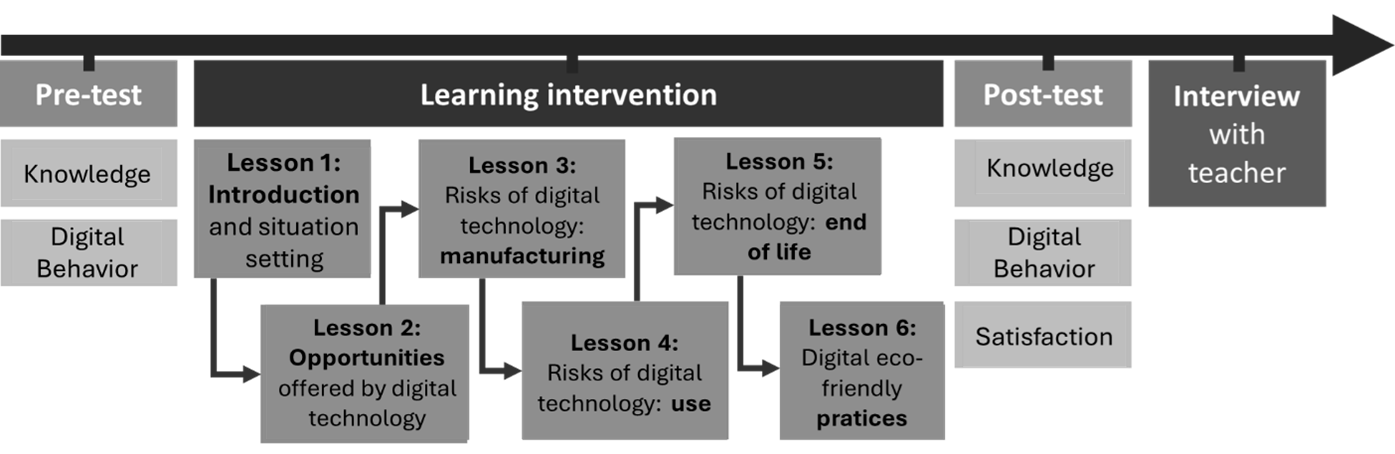
Figure 1 : Timeline of the case study and learning sequence design
The intervention was carried out over six weeks, using a pre-test/post-test design without a control group. It was structured into three phases:
Before the start of the learning sequence, participating pupils were invited to complete an online questionnaire. The purpose of this pre-test was to establish a baseline based on two complementary dimensions:
First, pupils’ knowledge of digital sobriety and the environmental footprint of digital technologies;
Second, their self-reported digital practices, including web browsing, online communication, management of their digital environment, and technology consumption habits. From among the responsible behaviors identified in the study by Descamps et al. (2023), only the eco-actions suited to our young adolescent audience were selected.
The learning sequence was designed in alignment with the model developed by Descamps et al. (2022), which interconnects three dimensions: understanding environmental impacts, using digital tools as drivers of ecological transition, and identifying concrete courses of action. The overall objective was to guide pupils toward an informed awareness of the environmental impact of digital technologies, while engaging them in critical reflection on their own practices.
The learning scenario unfolded over six weeks, each corresponding to a thematic session:
In the first session, pupils were invited to reflect on their representations of digital technologies. Image analysis and group discussions led to a central question: Are technologies a risk or an opportunity for the environment? A first excerpt from the animated film WALL·E (Stanton, 2008) served as a reflective trigger, facilitating debate around this question.
The second session had pupils work in pairs to analyze documents on the positive contributions of digital technology. Cross-presentations in class led to a collective synthesis of identified opportunities.
A second excerpt from WALL·E was used to introduce the concept of the life cycle of digital devices, focusing on the production phase. Using a set of documents, pupils conducted research to better understand the environmental impacts of this stage.
In the fourth session, pupils were asked to reflect on their daily digital habits, particularly related to energy consumption and device usage time.
Based on a documentary corpus, pupils first conducted individual research and then compared their findings in small groups, engaging in peer discussion and collaborative validation. A graphic synthesis illustrating the various stages of a device’s life cycle was produced.
To conclude the sequence, pupils first participated in a knowledge consolidation game. Then, using various resources, they were invited to identify eco-friendly digital habits they could adopt. Each pupil also created their own personal charter for responsible digital use.
The integration of selected excerpts from WALL·E (Stanton, 2008) represents a distinctive feature of this learning sequence. To enhance replicability, the film was used through carefully selected scenes at specific moments of the intervention, each serving a defined pedagogical purpose. These excerpts were chosen for their strong visual and narrative representation of key themes related to digital sobriety, including environmental degradation, overproduction, technological dependency, and waste accumulation.
The excerpts used are detailed as follows:
Excerpt 1 (Session 1 – introduction): 00:20:00 – 00:30:00. This scene, in which the robot EVE arrives on Earth to search for signs of life, was used as an introductory trigger. It supported pupils’ engagement by prompting inquiry-based discussion around the question “What happened to Earth?”, encouraging them to formulate initial hypotheses about environmental degradation.
Excerpt 2 (Session on environmental impacts): 00:01:00 – 00:03:30. This sequence depicts a deserted Earth covered in waste, with buildings blending into mountains of garbage and robots left to clean the planet. It was used to illustrate the environmental consequences of overproduction and waste accumulation.
Excerpt 3 (Session on environmental impacts): 01:07:00 – 01:10:00. This scene reinforces the dystopian vision by showing that planetary restoration has failed, making life on Earth impossible. It complemented Excerpt 2 in supporting the understanding of pollution, resource depletion, and environmental degradation.
Excerpt 4 (Session on digital practices and overconsumption): 00:36:30. This scene shows WALL·E entering the spaceship and discovering humans confined to floating chairs and absorbed by personal screens. It was used to introduce a debate on digital overconsumption and screen dependency, fostering critical reflection on pupils’ own digital practices and their relationship to technology.
Consistent with the recommendations of Thanya and Suganthan (2023), these excerpts were not presented as isolated viewing moments but were systematically embedded within structured pedagogical activities (debates, inquiry tasks, and collective discussions), functioned as both an emotional and cognitive mediating tool rather than a passive viewing experience. Across the sequence, the selected excerpts were aligned with the three dimensions of digital sobriety proposed by Descamps et al. (2022), namely understanding environmental impacts, critically examining digital practices, and encouraging the adoption of more responsible behaviours.
At the end of the learning sequence, a final questionnaire was administered to pupils under conditions similar to the pre-test. This post-test aimed to assess self-reported changes in knowledge and practices related to digital sobriety. In addition to the original questions, new items were included to gauge pupils’ satisfaction with the learning experience. These items used Likert scales to collect feedback on various learning activities (e.g., film excerpts, debates, games).
The questionnaire concluded with three open-ended questions, inviting pupils to share their personal impressions of the sequence, identify the key elements of their learning, and express their views on how these lessons might influence their future digital behaviors.
In parallel, a non-directive interview was conducted with the teacher who implemented the intervention. As the same teacher was responsible for all participating groups, the interview did not distinguish between the different classes, and no notable differences were reported. This qualitative component aimed to gather feedback on how the pupils received the sequence, any adjustments made during the sessions, and any levers or obstacles identified for potential future implementation.
Several studies have highlighted the educational value of the animated film WALL·E in the context of environmental education (Hamalosmanoğlu et al., 2020; Korfiatis et al., 2020). These works demonstrate that this fictional medium can foster ecological awareness, encourage responsible behaviors related to recycling, and promote critical thinking about the relationship between human societies and the planet, particularly among children aged 9 to 12.
In the present study, however, WALL·E was used within a different analytical framework: that of digital sobriety. The objective is to assess the effects of a pedagogical intervention rooted in a socio-constructivist approach and focused on the environmental impacts of digital technologies, aimed at pupils aged 12 to 14. This involves combining awareness-raising, critical reflection, and the adoption of eco-responsible digital behaviors.
Designed as a case study, this exploratory research seeks to answer the following three questions:
Q1: To what extent does the learning intervention support pupil progress in understanding the ecological footprint of digital technologies and the concept of digital sobriety?
Q2: Does the intervention lead to a change in pupils’ self-reported digital practices toward more sober and responsible behaviors?
Q3: How do pupils perceive the different pedagogical components (activities, games, film excerpts, debates) used to raise their awareness of digital sobriety?
This study is based on a convenience sample of first- and second-year secondary school pupils, adolescents aged 12 to 14 (average age: 13.57 years), enrolled in a school located in a disadvantaged urban area of the Federation Wallonie-Bruxelles (Belgium). The participating school has a socio-economic index of 2 out of 20, indicating a socially vulnerable environment marked by significant inequalities. This context may significantly influence pupils’ digital practices as well as their relationship to ecological and technological issues.
The pedagogical intervention was implemented during geography class across eight pupil groups: five in the first year of secondary school and three in the second year. In total, 140 pupils were exposed to the intervention, 96 in the first year and 44 in the second year.
Of these, 81 pupils completed the full research protocol by participating in both the pre-test and the post-test. This group constitutes the final sample used for analysis. The pupil breakdown within this sample is as follows:
59 first-year pupils (72.8%)
22 second-year pupils (27.2%)
Table 1 below presents the main characteristics of the final sample, including distribution by school level, gender, and average age:
| Gender | n | N | Average Age | ||
|---|---|---|---|---|---|
| Female | Male | ||||
| First year | 45.76 % (27/59) |
54.24 % (32/59) |
n1 = 59 | 81 | 13.57 years (σ = 0.79) |
| Second year | 54.55 % (12/22) |
45.45 % (10/22) |
n2 = 22 | ||
Table 1 : Characteristics of the sample
This section addresses the first research question: To what extent does the learning intervention support pupil progress in understanding the ecological footprint of digital technologies and the concept of digital sobriety?
To measure this progression, pupils completed a 20-point knowledge test before (pre-test) and after (post-test) the learning sequence. The resulting scores were used to calculate relative learning gains and relative losses, using the formula proposed by D’Hainaut (1975):
Gain = (Final score – Initial score) / (Maximum score – Initial score) × 100.
Loss = (Initial score – Final score)/Initial score x 100
This formula estimates the pedagogical effectiveness of the intervention while accounting for each pupil’s initial knowledge level. In accordance with methodological recommendations, only gains were analyzed, there was no need to assess relative losses.
| N | Pre-test (/20) | Post-test (/20) | Relative Gain (%) | ||||
|---|---|---|---|---|---|---|---|
| X̄ | σ | X̄ | σ | X̄ | σ | ||
| First year | 59 | 8.20 | 1.70 | 14.36 | 1.64 | 52.21 | 12.46 |
| Second year | 22 | 8.50 | 1.77 | 14.18 | 1.49 | 49.90 | 8.41 |
| All pupils | 81 | 8.28 | 1.72 | 14.30 | 1.60 | 51.58 | 11.54 |
Table 2: Relative gains in knowledge of digital sobriety
Table 2 presents the average relative gains per level (first and second year of secondary school) as well as for the full sample. The overall average relative gain is 51.58%, which clearly exceeds the 30% threshold set by D’Hainaut (1975) to consider a learning gain as significant. These results suggest that the learning sequence, grounded in a socio-constructivist approach and incorporating the animated film WALL·E, had a positive effect on pupils’ knowledge of digital sobriety and the environmental footprint of digital technologies.
The comparison between school levels reveals minimal differences. First-year pupils achieved an average gain of 52.21%, compared to 49.90% for second-year pupils. This similarity was confirmed statistically. A Shapiro-Wilk normality test indicated a normal distribution for first-year data (p = 0.236), but not for second-year data (p = 0.008). As a result, a Mann-Whitney test was conducted, showing no statistically significant difference between the two groups (U = 798.0; p = 0.367).
These findings suggest that school year did not influence the effectiveness of the intervention. In other words, knowledge acquisition appears to be independent of grade level, which supports the pedagogical transferability of the sequence to both first and second-year pupils. This opens promising perspectives for broader integration of digital sobriety education from the early years of secondary school.
These quantitative results are also supported by the analysis of open-ended responses collected in the post-test. Pupils spontaneously expressed what had particularly struck them during the sequence. Many comments reflect a clear awareness of the environmental impact of digital technologies: “I didn’t know my phone polluted that much” ; “Global warming because of internet searches”. Some pupils also mentioned the social and ethical aspects of device production: “Children or adults working in horrible conditions in Africa” ; “People sacrificing their health for electronics”. The excerpt from WALL·E appears to have made a strong emotional impression, particularly through images of “Earth covered in trash” ; “What the world could become”. This variety of responses reflects not only a personal appropriation of the content, but also the effectiveness of an active, visual, and contextualized pedagogy in fostering reflective engagement among pupils.
This section addresses the second research question: To what extent does the learning intervention lead to changes in pupils’ self-reported digital behaviors related to digital sobriety?
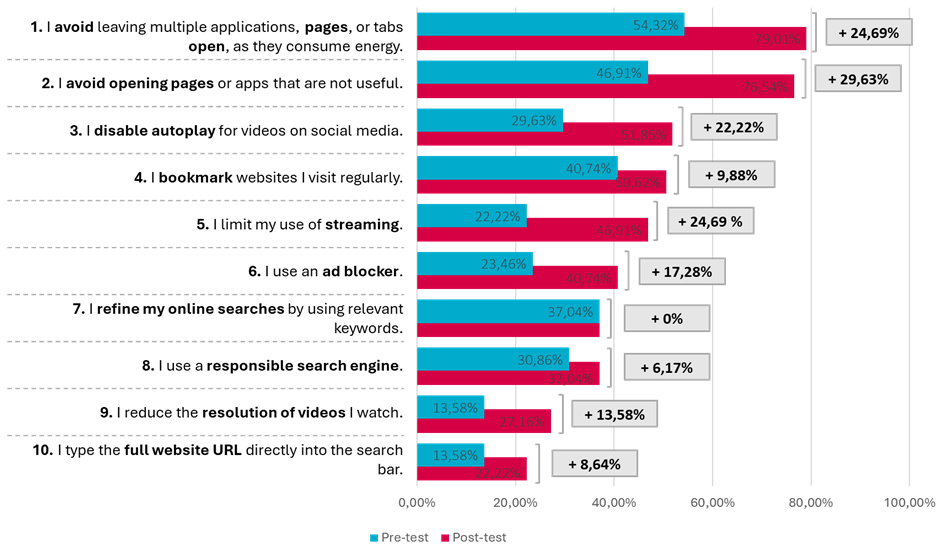
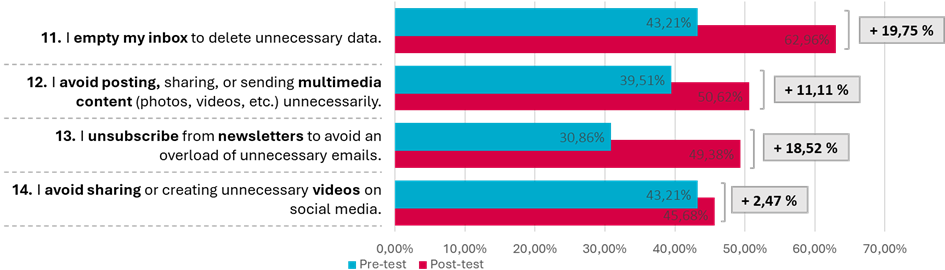
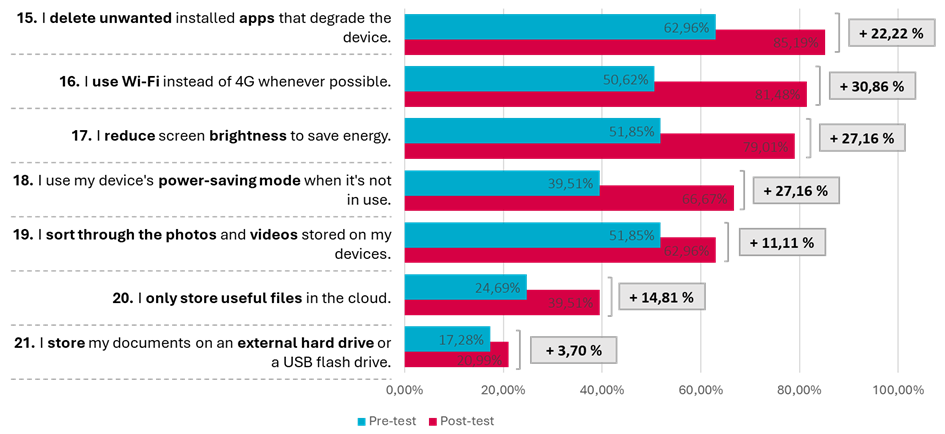
To explore this dimension, pupils were asked to indicate, before and after the learning sequence, the eco-responsible behaviors they reported practicing in their daily lives. The analysis is based on the four axes identified in the study by Descamps et al. (2023): online navigation, digital communication, management of the digital environment, and technology consumption. The following results reflect self-reported practices, which are more indicative of intention and awareness than of directly observed behaviors.
 Figure
2: Evolution of eco-friendly online navigation behaviors
Figure
2: Evolution of eco-friendly online navigation behaviors
As illustrated in Figure 2, pupils reported having adopted several behaviors to reduce their environmental impact while browsing online. The behavior with the largest increase was avoiding opening unnecessary pages or apps, with a gain of +29.63% between pre- and post-test (reported by 76.54% of pupils after the intervention). Two other behaviors increased by +24.69%: avoiding leaving tabs or apps open unnecessarily (79.01% post-intervention) and limiting streaming (46.91%). Similarly, disabling auto-play videos on social media rose by +22.22%.
In contrast, using keywords to refine online searches showed no change (+0.00%), likely because it was already optimized or perceived as routine. Given that this behavior relates to digital information literacy, it may require specific pedagogical attention to be further developed among pupils of this age (Kumps, 2024).
 Figure
3: Evolution of eco-friendly online communication behaviors
Figure
3: Evolution of eco-friendly online communication behaviors
Figure 3 shows the evolution of communication-related practices. Two behaviors stand out: unsubscribing from unnecessary newsletters (+18.52%) and regularly cleaning out email inboxes (+19.75%). The latter is now practiced by 62.96% of pupils, explicitly for ecological reasons. Additionally, 50.62% of pupils reported avoiding sending or sharing unnecessary multimedia content, with a gain of +11.11%.
 Figure
4: Evolution of eco-friendly actions related to digital environment
management.
Figure
4: Evolution of eco-friendly actions related to digital environment
management.
The results in Figure 4 indicate that pupils also adopted various eco-responsible behaviors related to managing their digital environment. The most improved behavior was using Wi-Fi instead of 4G (+30.86%; 81.48% of pupils post-intervention). Reducing screen brightness and using energy-saving mode both showed increases of +27.16%. Furthermore, deleting unnecessary apps reached a high implementation rate post-intervention (85.19%; +22.22%). Finally, sorting photos and videos was reported by 62.96% of pupils, up by +11.11%.
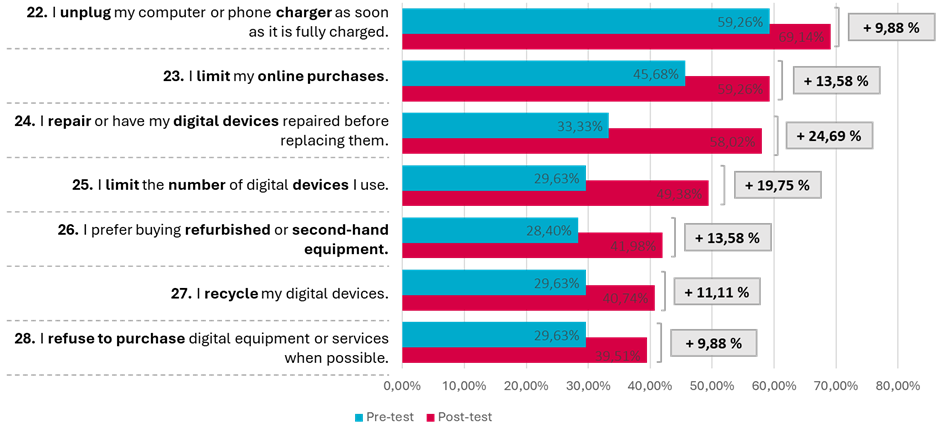 Figure
5: Evolution of eco-friendly actions related to technology
consumption
Figure
5: Evolution of eco-friendly actions related to technology
consumption
Lastly, Figure 5 focuses on digital consumption behaviors. The most significant increase was in repairing equipment before replacing it (+24.69%; 58.02% of pupils). Limiting the number of digital devices also increased (+19.75%), as did buying refurbished or second-hand devices (+13.58%) and reducing online purchases (+13.58%). In contrast, unplugging unused chargers showed a more modest increase (+9.88%), likely because this behavior was already relatively common before the intervention (59.26% at pre-test).
Beyond these results, qualitative insights gathered through open-ended responses and the teacher interview offer additional context. Some pupils expressed a desire to apply the advice they received or to raise awareness among those around them. For example: “I could apply some of the tips we learned during the sequence.” “By changing my habits or talking to my family about it.” The teacher confirmed this trend, noting that many pupils expressed a desire to "spread the message" to others.
This intergenerational transfer of learning is particularly promising, especially since several 12- to 14-year-old pupils also mentioned the limits of their agency, particularly regarding purchasing or upgrading devices, decisions typically made by their parents. However, the awareness gained during the sequence appears to have provided a foundation for initiating family discussions around these issues.
These findings suggest that the intervention fostered awareness and declarative engagement in concrete eco-responsible behaviors. They also indicate that the active and contextualized pedagogical format (film, debate, game, charter) helped anchor learning in pupils’ everyday realities. While actual behavioral changes could not be directly observed, these self-reported intentions represent a first step toward critical and engaged adoption of digital sobriety practices.
To complete the analysis of the learning intervention, this section addresses the third research question: How do pupils perceive the different pedagogical elements (activities, games, film excerpts, debates) used to raise their awareness of digital sobriety?
To assess this, pupils were asked to rate their level of satisfaction with various pedagogical formats using a scale from 0 (very dissatisfied) to 3 (very satisfied). The results of this evaluation are presented in Figure 6. Overall, the learning sequence was well received: a large majority of pupils reported being either rather satisfied (44.90%) or very satisfied (42.70%), indicating strong acceptability and perceived relevance of the intervention.
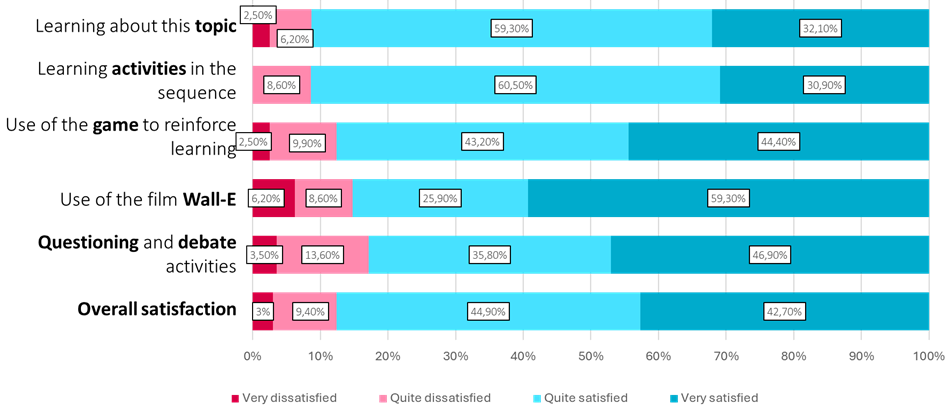 Figure
6: Satisfaction by pedagogical modality
Figure
6: Satisfaction by pedagogical modality
Among the evaluated pedagogical elements, the use of excerpts from the film WALL·E was the most appreciated (X̄ = 2.38; σ = 0.88). More than half of the pupils (59.30%) said they were very satisfied with it. The film’s emotional impact was frequently mentioned in open-ended responses, as illustrated by this pupil: “The scene showing what the Earth could become because of mining for precious metals and the waste being sent to other countries.” The teacher interview echoed this sentiment: “Many pupils didn’t know the film, and they really enjoyed it. Some even said the film made them want to take action so the world doesn’t end up like in WALL·E.”
The review game used at the end of the sequence to reinforce learning was also highly appreciated (X̄ = 2.30; σ = 0.75). It was seen as both engaging and useful. One pupil described it as one of the highlights of the entire sequence. The teacher confirmed its effectiveness: “The pupils reviewed the content without even realizing it, thanks to the playful format.”
The debates and inquiry-based activities, implemented within a socio-constructivist framework, were also positively evaluated (X̄ = 2.26; σ = 0.83), as was the overall set of learning activities (X̄ = 2.22; σ = 0.59). The teacher noted a high level of pupil involvement: “There were a lot of discussions and debates.” He also observed that pupils who are usually passive in geography class were much more engaged during this sequence, particularly when it came to sharing their personal experiences with digital technologies.
Finally, the overall appreciation of the topic itself was very positive (X̄ = 2.21; σ = 0.66). Pupils expressed genuine interest in this subject at the intersection of digital life and ecology. According to the teacher, it was precisely this connection between two familiar domains, the climate crisis, often seen in the media, and digital technology, a part of their daily lives, that sparked curiosity. One pupil remarked: “We don’t usually see the other side of things… when we buy something like a phone, we don’t necessarily know that behind it there’s pollution, resource extraction, and human exploitation.” This newfound awareness was confirmed by the teacher: “The pupils were sometimes really unaware of the reality.” Another pupil summed up the significance of the approach: “I think it was really important that we talked about this. Because we don’t realize, sitting behind our screens, everything that it causes.”
The results of this study highlight a significant improvement in pupils’ knowledge of the environmental footprint of digital technologies among 12- to 14-year-olds. The average relative gain of 51.58% in knowledge demonstrates the effectiveness of the learning intervention, regardless of the pupils’ grade level. This finding supports the value of a pedagogical approach rooted in socio-constructivism and aligned with the principles of digital sobriety education as conceptualized by Descamps et al. (2022).
These results are consistent with those of Wilson (2003), who suggested that well-structured educational interventions can yield similar learning outcomes among pupils of similar age ranges. In the present study, the absence of a significant difference between grade levels, despite a larger sample in the first year, suggests that the chosen approach helped overcome age- or grade-related differences, supporting its pedagogical transferability across different educational stages.
Socio-constructivist pedagogy appears to have played a central role in facilitating students’ engagement and learning. By emphasizing knowledge co-construction, peer interaction, critical discussion, and problem-solving, the intervention employed well-established levers known to be effective in environmental education (Fortin-Debart, 2013; Robottom, 2004; Arik & Yilmaz, 2020).
The use of the animated film WALL·E as a central educational resource further strengthened this dynamic. Its emotional and narrative power supported pupil engagement, deepened their understanding of the issues, and helped transform their attitudes and behavioral intentions, confirming the findings of Korfiatis et al. (2020) and Thanya & Suganthan (2023). The structured and purposeful integration of the film into the learning design went beyond mere passive reception of an environmental message, aligning with the recommendations of Brereton (2014) and Hamalosmanoğlu et al. (2020), who stress the need for explicit pedagogical framing to fully harness the educational potential of fiction.
Qualitative results also show strong reflective engagement: many pupils expressed a desire to share their learning with others, particularly with family members. This willingness to "spread the message" reflects a social appropriation of knowledge, echoing the goals of environmental education, which aims to equip young people to become agents of change (Fortin-Debart, 2013). At the same time, some pupils pointed out the limits of their agency, especially regarding decisions about technology purchases, which are typically made by their parents. This highlights the complex dynamics involved in adopting eco-responsible behaviors in the private sphere.
These findings reinforce the idea that digital sobriety education cannot be reduced to a set of normative instructions or technical tips. It requires a systemic approach that connects technical, social, political, and ethical dimensions of digital technologies (Descamps et al., 2022; Ripoll, 2025). In this regard, the study’s findings resonate with Flipo (2025), who argues for moving beyond energy-efficiency discourse to critically examine our broader digital lifestyles and their consequences.
Despite these encouraging findings, certain methodological limitations should be acknowledged. First, the absence of a control group prevents a definitive causal link from being established between the intervention and the observed outcomes (Weidmann & Miratrix, 2019). Second, responsible digital behaviors were measured through self-reported data, which may be subject to social desirability bias, a well-known issue in studies of self-reported ecological behavior (Dupré et al., 2014). To strengthen the validity of such research, future studies could incorporate mixed methods, including direct observation, usage diaries, or digital trace data (logs) to triangulate findings.
Additionally, a longer-term follow-up would be necessary to assess the durability of behavioral changes. Replicating the intervention in other geographical or sociocultural contexts would also help evaluate its transferability. These avenues would be valuable extensions to enhance the scope and robustness of this type of educational initiative.
It is important to note that this study was conducted as a case study, designed to address a locally identified need and focused on a learning objective that remains emergent in formal curricula: digital sobriety. This methodological stance, based on co-construction between researchers, teachers, and students, aims less to produce generalizations and more to highlight concrete pedagogical possibilities, in line with the principles of action-oriented research (Paillé & Mucchielli, 2012; Mercier & Trichet, 2023).
In summation, this study demonstrates that an approach grounded in adolescents’ digital culture, supported by active and critical pedagogies, can not only enhance knowledge but also foster responsible attitudes. At a time when ecological and technological challenges are increasingly intertwined, integrating digital sobriety into educational practice emerges as a meaningful and urgent necessity.
Arık, Selçuk & Yılmaz, Mehmet. (2020). The Effect of Constructivist Learning Approach and Active Learning on Environmental Education: A Meta-Analysis Study. International Electronic Journal of Environmental Education. 10. 44-84.
Bader, B. (1998). Une vision socialisée des sciences au service d'une éducation relative à l'environnement socioconstructiviste. Canadian Journal of Environmental Education, 3, 156-175
Bédard, M. G. (2005). La méthode des cas : guide orienté vers le développement des compétences (2e éd.). Gaëtan Morin.
Berthoud, F. (2017). Numérique et écologie. Annales des Mines-Responsabilité & environnement, 87 (3), 72-75. https://doi.org/10.3917/re1.087.0072.
Brereton, P. (2014). Animated Ecocinema and Affect: A Case Study of Pixar’s UP. Dans A. Weik von Mossner (Éd.), Moving Environments: Affect, Emotion, Ecology, and Film (chap. 9, pp. 281–309). Waterloo, Canada : Wilfrid Laurier University Press.
Caron, M., & Maurel, R. (2023). Penser la transition numérique : Vers un monde digital durable. Éditions de l’Atelier.
Cellard, L., & Marquet, C. (2025). Matérialités environnementales du numérique. RESET, 15. https://doi.org/10.4000/14adk
D’Hainaut, L. (1973). Etude d’une nouvelle variable pour l’analyse statistique des expériences pédagogiques. Bulletin De Psychologie, 26(305), 622-630.
Descamps, S., Boumazguida, K., Temperman, G., & De Lièvre, B. (2023). Sobriété numérique et acteurs de l’éducation : analyse croisée de leur sentiment de compétence et de leurs usages déclarés. Distances et Médiations des Savoirs, 43. https://doi.org/10.4000/dms.9259
Descamps, S., Temperman, G., & Lièvre, B. D. (2022). Vers une éducation à la sobriété numérique. Humanités numériques, (5). https://doi.org/10.4000/revuehn.2858
Dupré, M., Meineri, S., & Guéguen, N. (2014). Communication engageante appliquée au tri sélectif: comparaison entre les techniques du pied-dans-la-porte et du double-pied-dans-la-porte. Les cahiers internationaux de psychologie sociale, 102(2), 259-284. https://doi.org/10.3917/cips.102.0259.
Fédération Wallonie-Bruxelles. (2022). Référentiel de formation manuelle, technique, technologique et numérique (FMTTN). Fédération Wallonie-Bruxelles Accessed on http://www.enseignement.be/index.php?page=23827&do_id=17242&do_check=CNEJLFQGEC
Flipo, F. (2025). L’impératif de la sobriété numérique : enjeux et définitions. Humanités Numériques, 11. https://doi.org/10.4000/1498s
Fortin-Debart, C. (2013). Pour une approche coopérative de l’environnement à l’école primaire. Éducation relative à l’environnement – Regards, Recherches, Réflexions, 11, 1-19. https://doi.org/10.4000/ere.3905
Garnier, C., Bednarz, N., & Ulanovskaya, I. (2009). Chapitre 17. L'apprentissage comme activité collective: choix et organisation des activités selon les courants russe et socio-constructiviste. In Après Vygotski et Piaget (pp. 259-279). De Boeck Supérieur.
Hamalosmanoğlu, M., Kızılay, E., & Saylan Kırmızıgül, A. (2020). The effects of using animated films in the environmental education course on prospective teachers’ behavior towards environmental problems and their attitude towards solid waste and recycling. International Online Journal of Education and Teaching, 7(3), 1178–1187.
Korfiatis, K., Photiou, M., & Petrou, S. (2020). Effects of eco-animations on nine- and twelve-year-old children’s environmental conceptions: How WALL-E changed young spectators’ views of earth and environmental protection. The Journal of Environmental Education, 51(5), 381–394. https://doi.org/10.1080/00958964.2020.1747965
Kumps, A. (2024). Former les enseignants à la didactique de la recherche d’information en ligne à partir des pratiques effectives des élèves [Thèse de doctorat, Université de Mons, Faculté de psychologie et des sciences de l’éducation].
Legendre, M. F. (2008). Un regard socioconstructiviste sur la participation des savoirs à la construction du lien social. Éducation et francophonie, 36(2), 63-79. https://doi.org/10.7202/029480ar
López Fuentes, A. V. (2022). Environmental Education Through the Use of WALL-E and the Index for Inclusion. Communication présentée à la conférence ECER 2022 (European Conference on Educational Research), Yerevan, Arménie.
Mercier, C., & Trichet, F. (2023). Accompagner les formateurs et les étudiants à la sobriété numérique. Distances et Médiations des Savoirs, 43. https://doi.org/10.4000/dms.9449
Ouellet, F. (2005). Socioconstructivisme et éducation à la citoyenneté. In Le cégep, pour savoir agir: actes du 25e Colloque de l'AQPC, p. 68-86. Association québécoise de pédagogie collégiale,.
Paillé, P. et Mucchielli, A. (2012). L'analyse qualitative en sciences humaines et sociales. Armand Colin. https://doi.org/10.3917/arco.paill.2012.01.
Redecker, C., & Punie, Y. (2017). European Framework for the Digital Competence of Educators. Luxembourg : Office of European Union. European Commission. Accessed on the address https://publications.jrc.ec.europa.eu/repository/handle/JRC107466
Ripoll, É. (2025). Sensibiliser les étudiants à la sobriété numérique dans la gestion de projets en humanités numériques. Humanités Numériques, 11. https://doi.org/10.4000/1498v
Robottom, I. (2004). Constructivism in Environmental Education: Beyond Conceptual Change Theory. Australian Journal of Environmental Education, 20(2), 93-101
Soares, A.( 2013). Comment parler d’écologie aux enfants ?. Le Baron perché.
Stanton, A. (Director). (2008). WALL·E [Film]. Pixar Animation Studios; Walt Disney Pictures.
Thanya, R., & Suganthan, C. (2023). Enhancement of learners’ receptive skills through task-based activities to understand the eco-centric issues using WALL-E. World Journal of English Language, 13(7), 490–498. https://doi.org/10.5430/wjel.v13n7p490
Weidmann, B., & Miratrix, L. (2019). Lurking Inferential Monsters ? Quantifying bias in non-experimental evaluations of school programs. arXiv (Cornell University). https://doi.org/10.48550/arxiv.1910.07091
Wilson, Valerie. (2003). All In Together? An overview of the literature on composite classes. University of Glasgow
Yin, R. K. (2014). Case Study Research: Design and Methods (5th ed.). SAGE Publications.
Yustina, P., Osman, K., & Meerah, T. S. M. (2011). Developing positive attitudes towards environmental management: Constructivist approach. Procedia – Social and Behavioral Sciences, 15, 4048–4052. https://doi.org/10.1016/j.sbspro.2011.04.412
Address for corresponding author sarah.descamps@umons.ac.be↩︎